
August 3rd, 2026
4 min read
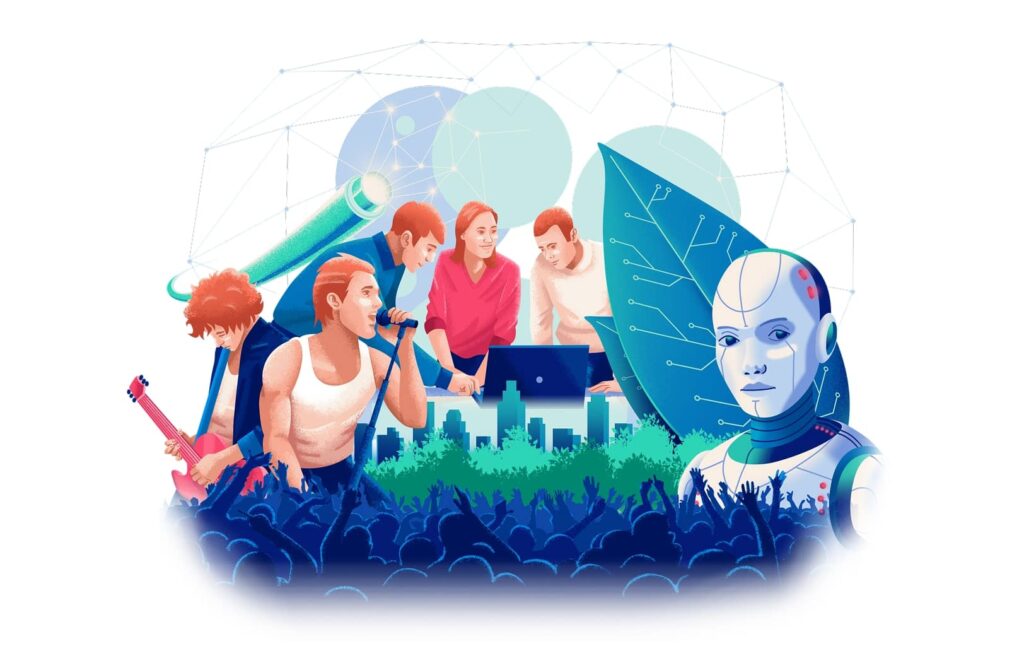
Most of the technology that transforms daily life is invisible. We don’t notice the power grid until the lights go out, or the fiber-optic cables under the sea until our video calls freeze. But behind every real-time experience is an infrastructure system designed to keep pace with our lives.
One of the most ambitious efforts to reimagine that foundation is underway: the Innovative Optical and Wireless Network (IOWN), developed by NTT and global partners. By replacing traditional electrical transmission with light—using advanced photonics and software integration—these next-generation frameworks and technologies deliver massive bandwidth, near-zero latency, enhanced security and dramatically lower energy use.
The goal, however, isn’t just technical performance. “Even though machines can now sense and act far faster than humans, infrastructure must still serve people,” says Yosuke Aragane, NTT vice-president and head of the IOWN Development Office. “Our design is human-centric. We want people to feel a richer connection without even thinking about the network behind it.”
The technology is being proven through the IOWN Global Forum, a cross-sector alliance founded in 2020 with more than 160 members. “We share real-world problems and work together to create solutions,” Aragane explains. “It’s not about technology for its own sake, but technology that solves human and societal challenges.”
Primetime Quality for All
One of IOWN’s most striking demonstrations came during the Japan Record Awards, one of nation’s most-watched television events. For the first time, the show’s live audio was mixed remotely, with no production trucks or technicians on site. Engineers worked from a studio in Tokyo, connected to the venue via IOWN’s photonic network.
That link—called an All-Photonics Network or APN—uses photonics end-to-end instead of electrons to transmit data. It’s fast enough to move dozens of high-fidelity streams in real time, with almost no delay and near-perfect reliability.
For TBS Television’s Yuki Katsumata, this solves a pressing challenge: “It’s incredibly challenging to secure enough highly skilled media operators to meet demands, especially in rural areas. TBS needs to keep up with the times while maintaining the quality of our programs. IOWN may be a game changer for us.” That “game changer” lies in centralizing production. Teams can now manage live broadcasts from hundreds of kilometers away, reducing cost, travel and logistical complexity—in turn, helping them create a greater variety of high-quality broadcast content.
One Infrastructure, Three Transformations
IOWN removes traditional limits on live production—cost, crews and geography—making high-quality broadcasting possible anywhere.

Flagship Event
Challenge: Costly trucks and on-site crews limit coverage of major events.
Technology: Remote production over APN links venues to studios with <5ms latency
Outcome: Drives lean, scalable coverage of large-scale events with lower emissions and cost.

Local Sports
Challenge: Too expensive to justify filming small-town games or tournaments.
Technology: Shared remote tools enable low-cost, high quality coverage; no crews required.
Outcome: Boosts visibility for local talent, community pride and sponsorship.

Cultural Moments
Challenge: No infrastructure to capture grassroots theatre debates or community festivals.
Technology: Studios can tap into live feeds on demand, without dedicated gear or staff.
Outcome: Amplifies regional stories and diverse voices bringing culture to national screens.
Sony’s Hiroshi Kuno sees an entire new model emerging: “This technology allows media production resources and network resources to be shared as a service. By becoming an industry standard, we can build an ecosystem that makes media production more efficient and creative.”
Aragane agrees. The real opportunity, he says, is in democratizing access. “We’re taking capabilities once reserved for national broadcasters and putting them in everyone’s hands—from local sports teams to community theaters to independent creators.”

Navigating High-Risk Environments
Factories, chemical plants and remote industrial sites face a different challenge: safety and precision in environments where human presence is risky or impractical. In a proof-of-concept, Mitsubishi Chemical Group and NTT partners ran inspections via smart robots connected over IOWN.
Engineers in Tokyo controlled robots at a Kashima plant 120 kilometers away in real time, transmitting high-resolution video to detect anomalies. AI identified wall-pipe cracks and detected vibrations as small as 0.1mm, feeding results directly into a digital twin of the facility. “Predictable latency is crucial here,” Aragane notes. “Operators need consistency so that remote control feels natural and safe.”
Hiroshi Miura, NTT DATA’s senior manager of the IOWN Innovation Office, agrees: “In factories, many machines need to be controlled from safe areas and we need to be very fast. With IOWN, you can remotely operate a robot or device in real time.”
The implications go beyond safety: fewer site visits, lower costs and access to specialist expertise anywhere in the world.
From Legacy Systems to Intelligent Infrastructure (2020 – 2024)
Based on WSJ Intelligence data, C-suite decision-makers have steadily shifted from crisis-mode infrastructure to intelligent systems built for responsiveness and resilience.
-

2020
Infrastructure Takes a Global Hit70%
See the global supply chain as having massive to substantial impact on their corporate strategy25%
Believe robotic process automation will eliminate repetitive rules-based tasks and free employees for higher valued-added work -
2023
Infrastructure Becomes a Resilience Engine Takes a Global Hit45%
-
2024
Infrastructure as Co-Pilot• Growth Technology Investment by 10% or More in 2025
IoT 30%
Automation 28%• Photonics Familiarity and Interest Level
Familiar 90%
Interested 93%
“Even though machines can now sense and act far faster than humans, infrastructure must still serve people.”
Banking on Resilience
Resilience runs through every IOWN application—from media to manufacturing to finance. In banking, the stakes are especially high: downtime erodes trust instantly and data loss can be catastrophic.
“Modern society faces constant risks—natural disasters, cyberattacks, terrorism—so preparation is vital,” says Yuichiro Moto, senior managing executive officer at MUFG Bank. “Ensuring both customer convenience and safety is a constant priority. IOWN’s ability to support secure, long-distance communication and reliable backups makes it a powerful tool.”
For mission-critical systems, IOWN enables disaster recovery with near-zero data loss, thereby reducing the risk of economic loss and fraud. It also supports service restoration in under 30 minutes, with the bandwidth and speed required to rapidly bring financial systems back online after a failure. “Banks must protect customer data at all times,” adds NTT DATA’s Miura. “If a fire or earthquake disables the main data center, operations can instantly shift to a backup. With a photonic link between sites, the transition happens in real time so service to customers continues uninterrupted.”
These same capabilities support faster, safer day-to-day operations, from AI-powered fraud detection and quantum cryptography to high-frequency trading—making IOWN a quiet but essential part of the future of finance.
What’s at Stake?
One hour of downtime in a Tier 1 bank can lead to:
-
$7M
lost in trades -
500,000
user access failures
-
3+
regulatory breach triggers -
Weeks
of trust to rebuild
A Hidden Engine for the 2030s
From primetime broadcasts to high-risk industrial sites to the vaults of the financial system, IOWN is proving itself as a foundational technology for the next decade. The roadmap already extends beyond connectivity, with future versions embedding photonics deeper into computing, data centers and personal devices, reducing energy consumption and shrinking delay for AI and edge applications.
“IOWN will allow more natural interactive communication for all people,” says Aragane. “It’s not just about making things faster; it’s also about making the infrastructure fade into the background so that what people notice is the experience, not the network.”
By the time most people realize how much of their life depends on it, IOWN may already be everywhere—a silent partner in the way a sustainable world works, connects and creates.
Wall Street Journal Custom Content is a unit of The Wall Street Journal advertising department.
The Wall Street Journal news organization was not involved in the creation of this content.