November 24th, 2025
4 min read
The world of technology is constantly evolving, bringing with it excitement about what the digital age might deliver. Ten years ago, the Fourth Industrial Revolution– as it was called – was widely anticipated for how it would reshape personal lives, business, and society at large.
How speed-of-light technologies will improve daily life, work, and society at large
But the predictions have only partially come true. Take autonomous vehicles, for instance. Futurists predicted that a synchronized flow of self-driving autos would occupy our highways by 2025, easing our daily commute, then drop us off at our destination and park themselves. We do have assisted driving today, and it is an improvement, but it is an incremental one. Most of us must still drive and park our vehicles ourselves.
There’s a gap between expectations and reality in the business world, too. Factories and farms don’t operate independently, with little or no human intervention, as imagined. Retailers have not yet created fully immersive virtual environments where customers try on products before purchasing. Digital business meetings continue to occur on screens and in 2-D rather than in virtual and immersive rooms.

Society overall has yet to see the giant leaps in health care, education, work-life balance, and digital experiences envisioned in recent years. Perhaps most concerning of all is how the widespread pace of new technology adoption, such as Artificial Intelligence, is pushing our planet and nature to its limits and beyond. Communications and computing technology already consume increasing amounts of energy, with AI adding to that at an even faster pace. We lack scalable solutions for reducing the impact on climate change.
What humanity does have is the knowledge and, hopefully, the will to resolve these challenges. We have what it takes to propel the digital age to the next level while protecting nature and people. A powerful new technological revolution, based on artificial intelligence, is on the horizon.
To achieve this new reality, we must revolutionize the underpinnings of the infrastructure and intelligence of our systems in a way that won’t harm the environment. We need a new and transformational approach – an approach based on optical technologies. IOWN is our commitment to help us all get there.
What is Innovative Optical and Wireless Network (IOWN)?
IOWN is a transformational concept of moving from electronics to photonics for networking and computing. It is based on a set of fundamental technologies, methods, and approaches that together make possible a secure, connected, immersive, and sustainable future.
Why is a move to photonics essential? It’s because, at best, doing nothing to change how we transmit and process information means progress will stall. At worst, staying on the current course accelerates and deepens risks to the future of our environment.

Electricity usage from data centers, artificial intelligence (AI), and crypto mining is forecasted to double by 2026, according to the International Energy Agency 1. AI alone could consume as much as a medium-sized country like Ireland or Argentina 2. Generative AI uses as much energy to make a single image as it takes to completely charge a cell phone, according to the Massachusetts Institute of Technology 3.
At a time when power grids are already experiencing overloads, imagine the effects on our energy supply of millions or billions of GenAI projects per day. The proliferation of connected home appliances, devices, consoles, vehicles, sensors, wearables, servers, and storage will only add to our energy consumption.
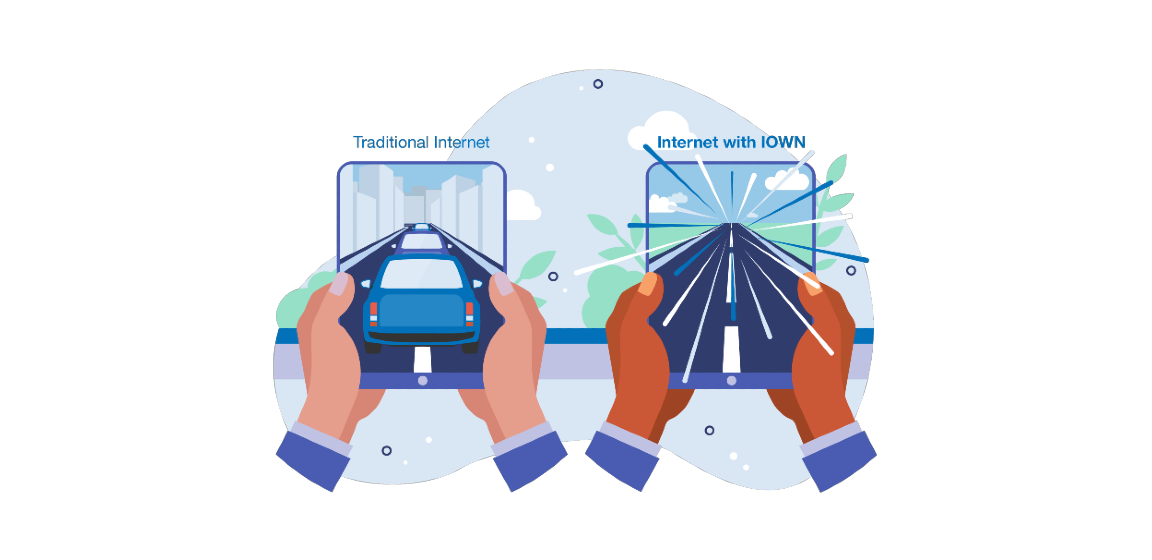
At the same time, technology innovations are also being limited by the laws of physics. The inherent latency (response time) involved in moving electronic data across today’s networks limits what is possible with virtual reality, autonomous vehicles, global storm-watch sensors, remote medical procedures, and other innovations.
To find solutions to these limits, we need technologies for networks and computing that are both fast and sustainable. Getting there requires solving the problem at the root of the digital dilemma: electrons. That’s where IOWN comes in.
The electron in the room
Modern digital technologies and infrastructure are electronics-based, meaning they use electrons to send information across networks and for computing. However, electrons are relatively slow and require a lot of energy to move. Photons move much faster and consume far less energy, making them an ideal solution for high-speed, low-power data transmission and computing. IOWN uses photonics – or light – to enable a secure, connected, and immersive future that’s also sustainable.
Key benefits of IOWN
IOWN is not just a concept or a vision for the future; it’s a real solution that’s already being deployed in various parts of the world.
Speed
IOWN promises to be much faster than today’s digital infrastructure, thanks to the use of light instead of electrons. This means that we will be able to transmit and process data much more quickly, opening new possibilities for innovation and progress.
Capacity
As the amount of data we generate and process continues to grow, we need a digital infrastructure that can keep up. IOWN can deliver the capacity we need, thanks to the use of photonic technologies and approaches that enable highspeed, low-power data transmission and computing.
Power consumption
The energy consumption of today’s digital infrastructure is a significant concern, both in terms of cost and environmental impact. As a photonics-based approach, IOWN will require much less energy to move data.
Security
With the ever-increasing amount of sensitive data being transmitted and processed across digital networks, security is a critical concern. Photonic technologies and approaches are inherently more secure than electronics-based solutions.
Immersion
As we continue to explore new possibilities for virtual and augmented reality, we need a digital infrastructure that can deliver immersive experiences. Because photonics enables high-speed computing, IOWN promises to deliver such experiences.
Key technologies and approaches that make IOWN possible:
-

Photonic devices
The building blocks of IOWN, enabling the transmission and manipulation of light for data transmission and computing. -
Optical fiber
The backbone of IOWN, providing the infrastructure for high-speed, low-power data transmission across long distances. -
Edge computing
A key approach for reducing latency and improving the performance of digital systems, by moving computing closer to the source of data. -
Quantum cryptography
A cutting-edge approach to digital security, based on the principles of quantum mechanics, which can deliver unbreakable encryption for sensitive data. -
Artificial intelligence
How speed-of-light technologies
will improve daily life, work, and
society at largeA critical component of IOWN, enabling us to process and analyze vast amounts of data quickly and efficiently, and to make intelligent decisions based on that data.
The Digital Age
The digital age has the potential to transform our lives in ways that were once thought impossible. To realize that potential, we need a new digital infrastructure that’s both fast and sustainable. IOWN is a comprehensive solution that promises to deliver that infrastructure, by moving beyond electronics to embrace photonic technologies and approaches and enable a sustainable, secure, connected, and immersive future for all.
1 Executive Summary – Electricity 2024 – Analysis.” International Energy Agency
2 Erdenesanaa, Delger. “A.I. Could Soon Need as Much Electricity as an Entire Country.” The New York Times, October 10, 2023.
3 Heikkilä, Melissa. “Making an Image with Generative AI Uses as Much Energy as Charging Your Phone.” MIT Technology Review, December 1, 2023.