January 13th, 2026
4 min read
Photons were once best known as part of popular science fiction, so it’s remarkable how much progress real science has made, and how far photonics will take us soon. NTT believes photonics will change lives for the better and Photonics-Electronics Convergence (PEC), the patented optical engine from NTT, is a critical part of moving into that future.
PEC devices integrate electronics and photonics within computer systems to enable faster data transmission, higher performance and greater energy efficiency. The NTT R&D Forum 2025 gave us the opportunity to show the world and lead discussions on how PEC will transform data centers and sustainable computing to help improve lives in tangible and meaningful ways.
It’s important because we expect Information and Communications Technology (ICT) to keep advancing, and the world the industry is already facing a pressing sustainability crisis. Humanity’s further progress requires powerful new technologies and photonics and PEC are both part of our answer to this challenge. Already, NTT has created servers enabled by PEC devices that only use one-eighth of the electricity of traditional servers.
And this is just the beginning of a new age of computing.
The future is photonics everywhere
Through the IOWN Global Forum, NTT is working with more than 160 partners to accelerate this truly transformational concept that will help build the communications and computing infrastructure of the future.
Today, most of our devices and technologies, such as phones, watches, gaming, sensors, PCs, servers and networks, use electronics to process and transmit information. Electricity usage from data centers, AI, and crypto mining is forecasted to double from 2023 to 2026 according to the International Energy Agency. AI alone could consume as much power as a medium-sized country like Ireland or Argentina. It has created a digital dilemma, making the move to photonics essential because, at best, doing nothing to change how we transmit, and process information means progress will stall. At worst, staying on the current course accelerates and deepens risks to the future of our environment.
One way to address these needs is through a combination of optical technologies and a new approach to computing architecture, infrastructure, and data exchange: a concept NTT calls DCI (Data-Centric Infrastructure). As part of DCI, IOWN will use optical technologies to transform these electronic connections into photonic connections, increasing transmission speeds and improving responsiveness while consuming extremely low levels of power.
IOWN technologies allow NTT to create a more sustainable infrastructure, which will deliver faster speed networks with lower latency. That translates into different ways that we can serve people, customers and businesses. Looking forward, we believe this investment will have a long-term payoff for NTT and its customers.
For NTT the future is based on photonics everywhere, from the network all the way to the chip. And that will create a more sustainable technology and give us more opportunities to deliver valuable solutions, such having photonic technology in the chips in your phone.
PEC’s impact today and at R&D Forum 2025
If NTT’s commitment to long-term sustainability management is driven by photonics, then PEC devices are central to enabling ultra-low latency in the data centers while also boosting capacity and cutting power consumption.
NTT is steadily rolling out a phased adoption of PEC devices in stages under IOWN. These stages will extend from network infrastructure into computing systems.
In IOWN 1.0, PEC 1- devices were deployed in relay equipment at network connection points, and in network systems linking data centers and servers. These technologies supported the launch of high-capacity, low-latency network services, commercialized in 2023.
Launched in 2025, IOWN 2.0 marked the start of applying PEC devices inside computers. For example, with PEC-2 devices, NTT is replacing traditional electrical wiring between computer boards with optical links to create an optical engine in servers. NTT has developed technology that use just one-eighth the power of conventional systems, which it showcased at the NTT R&D Forum 2025.
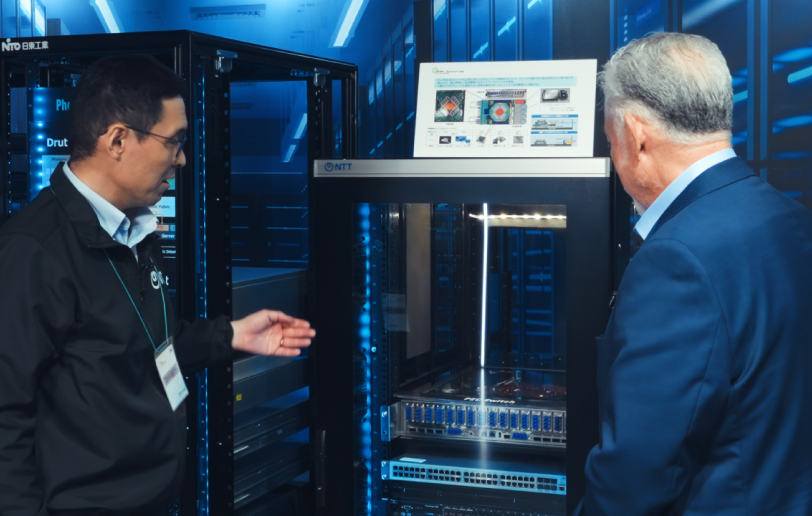
Also, on display at the R&D Forum were devices powered by PEC-2 technology and showcased in practical use:
-

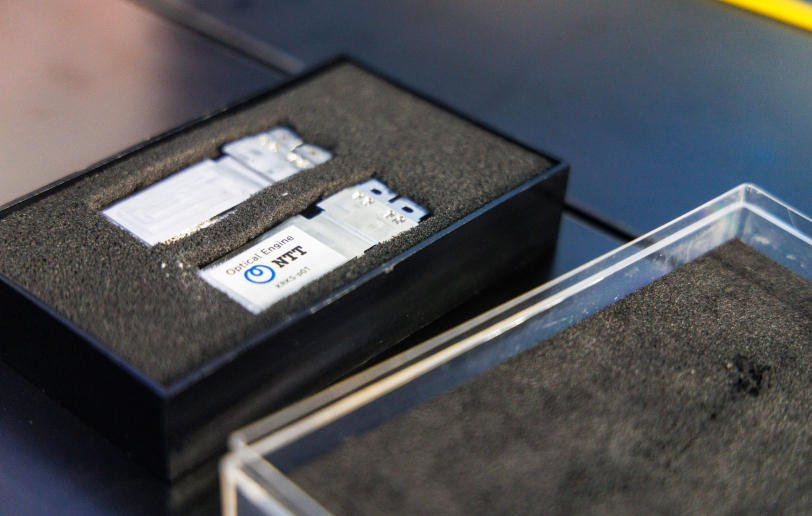
The PEC-2 is a compact photonics-electronics convergence device, about 20 mm wide, commonly referred to as a photonic engine. A single unit can transmit 3.2 terabits per second, which is equivalent to the data on 16 Blu-ray discs.
-
The PEC-2 switchboard allows seamless communication by switching between multiple transmission and reception channels. It integrates 16 PEC-2 devices within a single switchboard. The PEC switch, equipped with this switchboard, achieves an aggregate capacity of 51.2 terabits per second.
-
While the latest GPUs require 14.4 terabits per second, the PEC switch delivers more than triple that capacity, providing robust performance for advanced AI workloads.
Lower power consumption in future PEC devices
PEC capabilities will continue to advance rapidly in the near future. For example, when the commercial version of the PEC-2 switch releases in 2026 it will have an aggregate capacity of 102.4 terabits per second.
By 2028, with IOWN 3.0, communication between chips on the same board will shift to optical, delivering further reductions in power consumption. Traditionally, meeting higher computational demand required scaling by adding entire server units, each equipped with CPUs, memory, GPUs, and other components.
By contrast, IOWN 3.0 will directly connect components optically, enabling flexible configuration and use of only the required parts across a wide network. Furthermore, unused components can be powered off, delivering breakthrough reductions in power consumption. And around 2032 IOWN 4.0 will push photonic technology into the chips themselves.
A profound change in the way we live
It is now clear that photonics and PEC devices have the potential to transform our lives in ways once only imagined. As a founding member of the IOWN Global Forum, NTT has been at the forefront of working to change the way people, technology, nature and all things interact and connect.
The PEC devices on display and discussed at NTT R&D Forum 2025 demonstrate how recent progress is profoundly changing the communications and computing infrastructure of the future. By moving beyond electronics to embrace photonic technologies, NTT is working to enable a sustainable, secure, connected and immersive future for all.