
January 13th, 2026
3 min read
The possibilities of quantum computing are endless.
Picture a safer world where scientists can uncover the causes of hurricanes, tornadoes and other extreme weather events using global weather modelling and analysis. Or where researchers can accelerate drug development and create custom treatments tailored to a person’s individual genetic profile, leading to safer, more effective medications and new drugs that can prevent diseases we don’t even know about today.
Imagine how much safer and more streamlined shipping and transportation would be if people could instantly calculate the best routes for autonomous driving using real-time traffic data to minimize congestion across urban areas. And just think about how much more financially secure families could be if experts created optimal investment portfolios and strategies through the analysis of large-scale financial data.
This is the potential of quantum computing. With its ability to perform calculations at incredible speeds and instantly solve problems that would take a traditional top-performing supercomputer 100,000 years, quantum computing offers a huge opportunity to improve lives around the world.
But we aren’t there yet.
Although this year marked the 100th anniversary of the birth of quantum science, quantum computing in 2025 is still in the early stages of development. It faces major challenges in terms of scalability and error correction. At NTT, we are committed to driving transformative progress with quantum computing – and that’s why we made “Quantum Leap” the theme of our 2025 NTT R&D Forum.
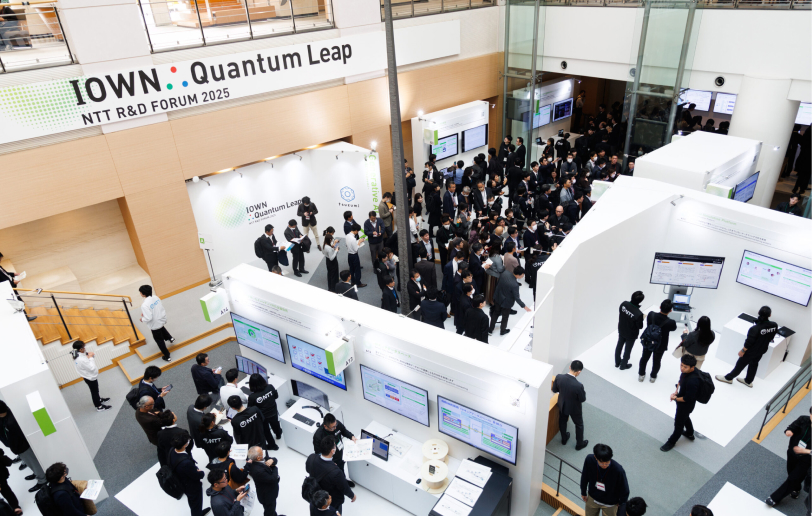
We are working toward a new type of quantum computer – called an optical quantum computer – with the goal of delivering a system that creates tangible real-world benefits in the next five to six years.
How optical technology will advance quantum computing
Classical computers are reaching their limits. They face growing energy challenges, as performance improvements are introduced and power consumption thus rises, and their processing speed is expected to eventually hit a ceiling. Quantum computers have the potential to overcome these limitations and are expected to play a key role in addressing a wide range of social challenges.
Integrating optical technology into quantum computing research can help to further advance development. For instance, quantum computing technology introduces noise into calculation results, which means it can only give a rough estimate of an answer for incredibly complex questions – not an exact answer. Optical technology can help to address this by using photons, which are far less susceptible to environmental interference, enabling more stable, low-noise qubits and allowing for precise, error-resilient quantum operations.
In addition, superconducting quantum computers will require cooling to near absolute zero and could only operate with large-scale refrigeration systems that consume significant amounts of energy. But optical quantum computers will be able to operate at room temperature, with photons traveling at high speeds and creating entangled states without the need for cooling systems, making them more resilient to heat and pressure.
NTT’s vision for optical quantum computing
NTT is leading the way in research and development into optical quantum computers. We are well-positioned to do so, given our extensive experience in optical communications, from submarine cables linking continents, to optical fiber networks that reach individual households. NTT is also one of the founding members of IOWN Global Forum, a concept and initiative aimed at realizing a world of well-being in which everyone can live smarter in their own way, based on next-generation information and communications infrastructure centered on optical technology.
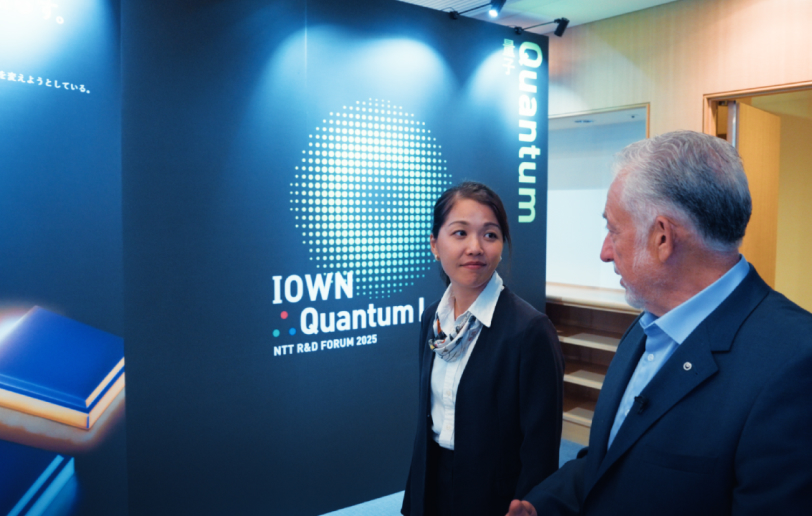
We have made significant progress toward the development of optical quantum computers. Highlights include:
-

November 2024:
A joint project team including NTT and Professor Akira Furusawa of the University of Tokyo launched the world’s first general-purpose optical quantum computing platform.
-
January 2025:
The team achieved another world first by applying highly quantum optical pulses to the system, which are essential for nonlinear operations required in universal quantum computing. That same month team swiftly achieved a series of breakthroughs, including real-time optical quantum entanglement generation more than 1,000 times faster than conventional methods. -
November 2025:
NTT and OptQC signed a collaboration agreement to develop scalable and highly reliable optical quantum computers, aiming to achieve one million qubits by 2030. The partnership will leverage NTT’s advanced optical communication technologies and OptQC’s expertise in optical quantum computing to accelerate practical implementation.
What comes next for quantum computing?
Through intense R&D, teams at NTT have developed an optical quantum computing platform that can be used today – but right now it can only do simple calculations. We aren’t stopping there, though. Optical quantum computing offers widespread benefits for better lives for people around the world and so we are working hard to realize its potential. We will be adding functions such as nonlinear operations and error correction, with the goal of enabling general-purpose, large-scale computation in the next five to six years. And, to further accelerate practical applications, we are building on our optical quantum computing platform to foster discussions and collaboration with our partners.
At NTT, we want to make lives better. We envision a day when optical quantum computing will be at the heart of long-term societal improvements in business, health, science, AI, and more, building a better future for people and the planet. Today, our people are working hard to make that vision a reality.
Definition: A qubit (short for quantum bit) is the basic unit of information in a quantum computer, similar to how a bit is the basic unit in a classical computer. When qubits interact, their states can become linked so that the state of one depends on the state of another, even across large distances. This property, called entanglement, allows quantum computers to perform powerful parallel computations.